

Lyrics
1. A noun names a person, place, thing, or idea. 2. A pronoun takes the place of a noun: I, you, he, she, it, we, they. 3. A verb expresses action or being: run, think, become, is. 4. An adjective describes a noun: the brilliant scientist. 5. An adverb modifies a verb, adjective, or another adverb: she spoke quietly. 6. A preposition shows relationship: in, on, under, through, before, after. 7. A conjunction joins: and, but, or, because, although. 8. An interjection expresses emotion: Wow! Alas! Ouch! 9. Every complete sentence needs a subject and a predicate. 10. The subject tells whom or what the sentence is about; the predicate tells something about it. 11. A phrase is not a complete thought; a clause contains a subject and verb. 12. Independent clauses can stand alone. Dependent clauses cannot. 13. Active voice is usually stronger: Lincoln wrote the letter is clearer than The letter was written by Lincoln. 14. Punctuation carries meaning. Compare Let’s eat, Grandma! with Let’s eat Grandma! 15. An apostrophe usually shows possession or missing letters—not an ordinary plural. 16. A simile compares using like or as: brave as a lion. 17. A metaphor says one thing is another: Time is a thief. 18. Personification gives human qualities to nonhuman things: The wind whispered. 19. Alliteration repeats beginning sounds: wild winds whistle. 20. Good writing favors strong nouns and verbs over piles of adjectives. 21. English is a wonderfully mixed language. Much of its core vocabulary is Germanic, while Latin entered heavily through French and scholarly language. 22. Latin helps unlock English vocabulary. Learning one root can illuminate dozens of unfamiliar words. 23. Aqua = water. → aquatic, aquarium, aqueduct. 24. Terra = earth/land. → terrain, territory, terrestrial. 25. Vita = life. → vital, vitality, vitamin. 26. Video = I see. → video, vision, visible. 27. Audio = I hear. → audio, audible, audience. 28. Portare = to carry. → transport, portable, import, export. 29. Scribere/scriptum = write/written. → describe, manuscript, inscription, scripture. 30. Words give you power to think. The larger and more precise your vocabulary becomes, the more precisely you can read, reason, explain, persuade, and recognize when someone else’s words are misleading you. ⸻ 🔬 SCIENCE — 30 Things Worth Knowing Biology + Chemistry + the physical world 1. Science asks questions about the natural world using evidence. Good scientific explanations must be testable against observations. 2. A hypothesis is a testable explanation—not merely a random guess. 3. Experiments change variables deliberately. A fair test tries to change one relevant factor while controlling others. 4. Matter is anything that has mass and occupies space. 5. Matter is made of atoms. You, oceans, rocks, stars, and air are all made from atoms. 6. Atoms contain protons, neutrons, and electrons. Protons and neutrons form the nucleus; electrons occupy the surrounding electron cloud. 7. The number of protons determines the element. Every carbon atom has 6 protons; every oxygen atom has 8. 8. The periodic table is a map of the elements. Its arrangement reveals repeating patterns in chemical behavior. 9. Atoms form chemical bonds by interacting through their electrons. 10. A molecule contains atoms chemically bonded together. Water is H₂O: two hydrogen atoms bonded to one oxygen atom. 11. Chemical reactions rearrange atoms. They don’t ordinarily create or destroy the atoms themselves. 12. Acids and bases can be described using pH. Below 7 is acidic, 7 is neutral, and above 7 is basic in the standard aqueous scale. 13. Energy cannot simply appear from nothing or vanish. It changes form and moves between systems. 14. Gravity attracts masses. It keeps you on Earth and helps govern the motions of planets, moons, and stars. 15. Earth orbits the Sun; the Moon orbits Earth. 16. Earth’s rotation causes day and night. Its axial tilt combined with its orbit around the Sun causes the seasons. 17. A cell is the basic unit of life. 18. Your body contains trillions of cells, specialized into tissues, organs, and organ systems. 19. DNA stores hereditary biological information. It contains instructions cells use to build and regulate living organisms. 20. You inherit DNA from both biological parents. 21. Genes are segments of DNA, and different versions of genes help produce inherited variation. 22. Plants use photosynthesis. They capture light energy to help turn carbon dioxide and water into sugars, releasing oxygen. 23. Cellular respiration releases usable energy from food. Your cells depend on it constantly. 24. Your heart is a muscular pump. It circulates blood that transports oxygen, nutrients, hormones, wastes, and other substances. 25. Your lungs exchange gases. Oxygen enters the blood while carbon dioxide leaves it.
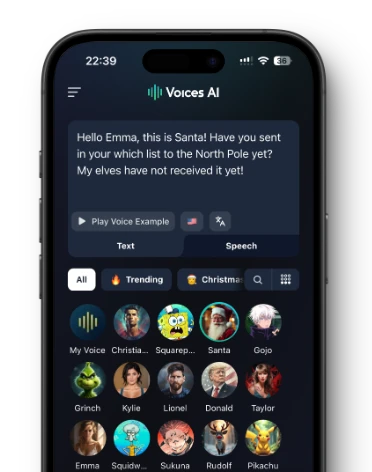
Generate Voiceovers & songs with AI
Download Voices AI
Create audio with more than 300 different voices in our library.
Recommended Songs
Discover the Future of Music with Our AI-Generated Songs Library
Welcome to the next generation of music creation with our AI Songs Library, where innovative artificial intelligence meets creative expression. Explore a vast selection of user-generated AI songs across genres, moods, and languages. From ambient and cinematic soundscapes to upbeat pop and deep, resonant tracks, our AI-driven technology brings unique, high-quality music to life, perfect for any project or personal enjoyment.
Whether you're a content creator, game developer, podcaster, or simply a music lover, our AI-powered song library offers something for everyone. Each track is crafted using advanced AI technology, ensuring realistic sound quality and a natural feel, with customizable options to suit your unique needs. From background scores to inspirational soundtracks, discover the versatility and depth of AI music on our platform.
Key Features of Our AI Songs Library:
- Wide Genre Selection: Discover songs across various music styles like pop, rock, hip-hop, classical, jazz, ambient, and more, all generated by advanced AI technology.
- Mood and Tone Customization: Easily find or create tracks that match the mood you need-whether it’s upbeat, chill, dramatic, or inspirational, our AI music offer the perfect vibe.
- Multi-Language Lyrics: Our library includes songs in multiple languages, including English, German, Spanish, and many others, expanding your reach and connecting with global audiences.
- Perfect for Multimedia: Use our AI song generator for background music, sound effects, or as a unique addition to your videos, podcasts, and presentations.
Why Choose Our AI-Generated Songs?
- High-Quality Sound: Our multi-language support means your music can engage listeners from around the world, making it perfect for cross-cultural projects.
- Endless Creativity: With AI-driven customization, each song can be uniquely tailored to fit your project’s needs, making it a valuable asset for creators.
- Global Accessibility: Our multi-language support means your music can engage listeners from around the world, making it perfect for cross-cultural projects.
- Easy Integration: Download and integrate songs effortlessly into your existing workflows, whether it’s for audio production, streaming, social media, or commercial use.
Browse our AI Songs Library now to explore user-generated music, crafted with cutting-edge AI technology. Find the perfect soundtrack for your content, elevate your projects with innovative soundscapes, and experience the future of music creation today.